
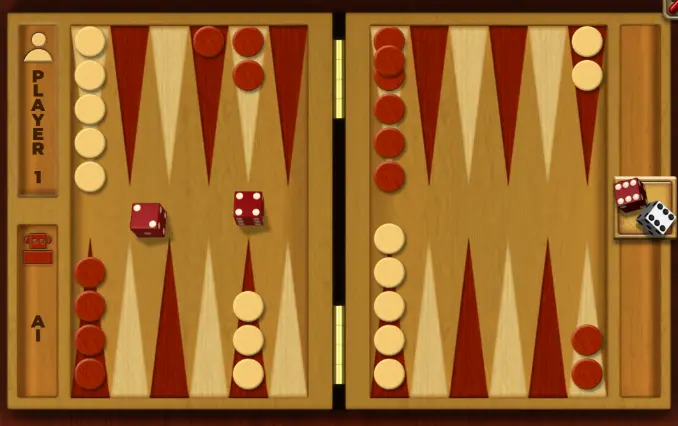
🎲 Classic Backgammon
Classic Backgammon is a timeless mix of dice luck and pure decision-making. Race your checkers home, manage risk, and use smart timing to turn a single roll into a winning plan.
About Classic Backgammon
Backgammon is a two-player strategy board game where both players move 15 checkers around a 24-point board. You roll two dice each turn, move according to the pips shown, and try to be the first to bear off all your checkers. What makes backgammon special is the constant balance between probability, positioning, and bravery.
A short history of Backgammon
Backgammon is widely considered one of the oldest board games still played in a recognizable form. Its roots are often traced back thousands of years to ancient race games, with later Roman-era versions helping shape the familiar “move-and-bear-off” idea. The modern rules and the name “backgammon” became popular in England centuries later, and the game’s competitive scene grew even more with the introduction of the doubling cube in the 20th century.
Board setup and key terms
- Points: The board has 24 triangles (points), numbered 1–24 from each player’s perspective.
- Checkers: Each player has 15 checkers.
- Home board: Your final six points (where you want your checkers to gather before bearing off).
- Outer board: The middle area you travel through before reaching home.
- Bar: The center divider; hit checkers go here and must re-enter.
- Bear off: Removing checkers from the board once all 15 are in your home board.
- Blot: A single checker on a point (vulnerable to being hit).
- Made point: A point occupied by 2+ of your checkers (safe).
- Prime: A chain of consecutive made points that blocks movement.
Rules and gameplay
Objective
Be the first to bear off all 15 of your checkers.
Turns and movement
- On your turn, roll two dice and move your checkers forward that many points.
- You can move one checker twice or two checkers once each (using both dice).
- If you roll doubles (e.g., 4–4), you play four moves of that number.
- You may not land on a point occupied by two or more opponent checkers (that point is blocked).
- You may land on a point with one opponent checker (a blot) and hit it.
Hitting and re-entering from the bar
- When you hit an opponent blot, that checker goes to the bar.
- A player with checkers on the bar must re-enter them before making any other moves.
- To re-enter, use a die to move a checker from the bar onto the opponent’s home board:
- One die enters on the corresponding point (1–6).
- If that point is blocked (two+ opponent checkers), you cannot enter using that die.
- If you cannot enter with one or both dice, you forfeit the unusable move(s).
Bearing off
- You may start bearing off only when all 15 of your checkers are in your home board.
- If you roll a number that matches a checker’s point, you may bear it off.
- If no checker is on that exact point, you may bear off the checker on the highest point below that number (if any).
- If you roll a number higher than your highest occupied point, you may bear off from your highest point.
- If you hit or are hit after starting to bear off, you must bring all checkers back into the home board again before continuing to bear off.
Scoring: single game, gammon, backgammon
- Single game: Opponent bears off at least one checker (win = 1 point).
- Gammon: Opponent bears off none (win = 2 points).
- Backgammon: Opponent bears off none and still has a checker on the bar or in your home board (win = 3 points).
The doubling cube (best-practice overview)
- The doubling cube starts at 1 and can be offered to double the stakes (1→2→4→8...).
- Only the player who owns the cube may offer the next double.
- When a double is offered, the opponent must choose:
- Take: continue with the new value.
- Pass: resign and lose the current value.
- Great cube decisions are about winning chances, gammon chances, and risk of losing, not just being “a bit ahead.”
Strategy best practices
1) Play the position type you’re in
- Racing positions: Focus on efficient pip reduction, avoid unnecessary contact, and keep your checkers moving.
- Contact positions: Build anchors, primes, and keep hitting threats alive.
- Blitz opportunities: If you can trap an opponent checker on the bar, attacking can outperform quiet play.
2) Value anchors and timing
- An anchor (a made point in the opponent’s home board) gives you safety and counterplay.
- Good backgammon is often about timing: keep checkers back long enough to maintain control, but not so long you get stuck.
3) Build points, then connect them
- Two checkers on a point is safety and structure.
- Connected points create primes that restrict your opponent’s movement and force awkward rolls.
4) Choose risk with a purpose
- Leaving a blot is not “bad” by default. It’s bad when the reward is small and the punishment is huge.
- Ask: What do I gain if I’m not hit? and How bad is it if I am hit?
5) Learn simple cube instincts
- Double when you have a strong advantage and the opponent still has a reasonable take.
- Take when you have enough winning chances (and/or strong gammon chances for the opponent are low).
- Pass when you are very unlikely to win and the position offers little swing potential.
6) Count pips to avoid surprises
- Pip count estimates race progress. Even rough counting improves bear-off and cube decisions.
- When ahead in a pure race, reduce contact and play safely.
- When behind, keep contact longer and look for hitting chances.
Game controls
- Mouse: Click/tap a checker to select, then click a destination point (or drag, depending on the version).
- Touch: Tap a checker, then tap where you want to move it.
- Use on-screen buttons for roll, undo, new game, or doubling cube if the version includes them.
Features
- Classic 24-point board and standard backgammon rules
- Fast turns with clear legal-move guidance (version-dependent)
- Perfect for learning fundamentals, cube basics, and race technique
Backgammon — Frequently Asked Questions
When can I start bearing off?
You can bear off only after all 15 of your checkers are in your home board.
What happens if I have a checker on the bar?
You must re-enter that checker first using your dice. If the entry points are blocked, you may lose part or all of your turn.
Can I move to a point that has my opponent’s pieces on it?
You can land on a point with one opponent checker (hit it), but you cannot land on a point with two or more opponent checkers (blocked).
How do gammons and backgammons work?
If your opponent bears off none, it’s a gammon (2x). If they bear off none and still have a checker on the bar or in your home board, it’s a backgammon (3x).
What is the doubling cube and when should I use it?
The cube lets you raise the stake when you have a strong advantage. Offer doubles when you’re ahead but the opponent still has a reasonable chance to continue (a “take”).
What is a pip count?
A pip count estimates how far each side is from bearing off in a race. It helps you choose safe racing moves and better cube timing.